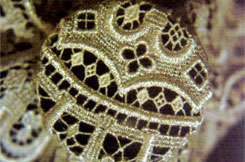
Bobbin Lace
While needle lace is commonly defined according to the technique used (reticello, punto in aria…), bobbin lace is usually named after the country where it is made, such as Genoa, Milan, the Flanders. The tools used to make this kind of lace are the bobbins, sort of small spindles on which the thread is wound and the tombolo, a stuffed, cylindrical pillow.
It is not known when exactly bobbin lace production began, either in Italy or in the Flanders, the two countries that rival each other about the invention of this type of lace, but from some documents it is possible to learn that both needle and bobbin lace developed together around the end of the fifteenth century. Bobbin lace can be worked with two different techniques: either with a continuous thread, using a set number of spindles, a technique that does not give the possibility to create large pieces; or in separate pieces, a technique that makes it possible for the lace maker to increase or decrease the number of the bobbins during his work and to assemble, with invisible stitches, the pieces worked separately.
Genoa and Venice held the supremacy in bobbin lace for a long time. In the first half of the seventeenth century the Flanders became the most prosperous country in Europe because of their abundance in raw materials, especially the finest linen, spun and blanched to perfection.
Further readings:
Cfr. A. Cantagallo,Ricamatori e Merlettaie, Foligno, 1991;
Cfr. A. Kraatz, Merletti, Milano, 1988.